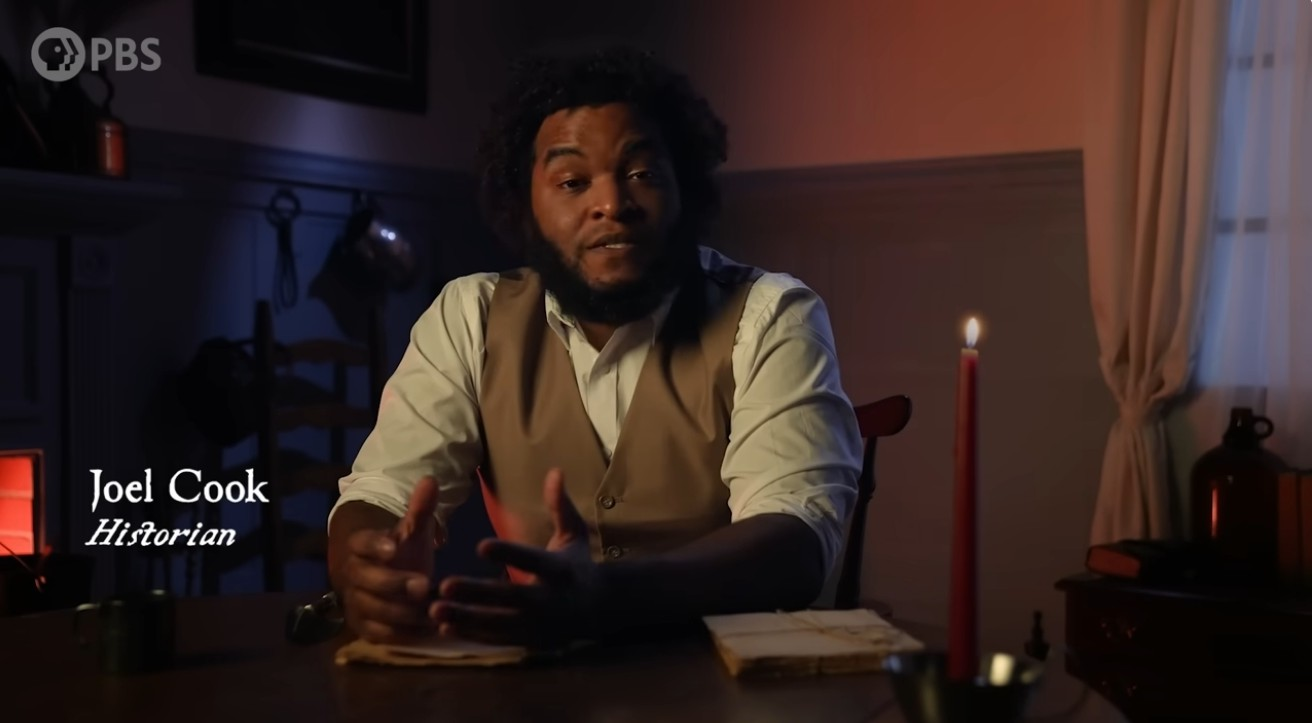

Dressed in colonial-era costume on a dimly lit set is Joel Cook, a professed historian and host of PBS Origins “Rogue History” video series.
by Jennifer Fry | Uvalde Hesperian
07/02/26
Top Image Credit: Public Broadcasting Service

The costume and setting is meant to invoke in viewers’ minds a sense of authority on the historical time period presented, in this case the Revolutionary War.
I recently came across a PBS Origins short-form documentary that fills me with a deep sense of ire, especially on the eve of our nation’s birthday. The presentation, posted to YouTube nine months ago from PBS’ “Rouge History” series, is called “The Founding Father They Don’t Teach You About.” The description of the episode identifies its purpose: it is “part of PBS’ America@250 collection, celebrating the country’s 250th anniversary.” What was presented is a story of the founding of a different country entirely.
When I read the headline (which is itself a snob-appeal fallacy), I was intrigued. I am student of history and pride myself on my knowledge of the events that shaped the country in which I live. I had, in fact, clicked off in my head the events of that history as recounted on a recent podcast I had listened to. Is there part of this history I didn’t know? Perhaps I should know it.
The fallacy worked. If you click on me, the video seemed to say—as it was indeed designed to do—I will impart to you the knowledge necessary to look smarter than all of your friends. The serpent in the Garden could not have said it better, or been more misleading.
I clicked on the video expecting to find new information to enlighten my understanding of the events surrounding July 4, 1776. “Founding Father” in this context meant everything I understood it to mean: One of the 56 delegates to the Continental Congress who signed the Declaration of Independence on that day, or, conversely, the framers of the Constitution and, thus, our government. By using the phrase “founding father” in its title and coupling the video with the 250th anniversary of the United States, this is indeed the association that PBS meant to invoke in its viewers’ minds.
Instead of a rousing retelling of the antics of Josiah Bartlett or Button Gwinnett—signers of the Declaration who get little, if any, mention in the history books—the host, Joel Cook, regales his audience with the story of a black man named Thomas Peters, an escaped South Carolina slave who fought on the British side of the Revolution, attempted settlement in Nova Scotia (a British colony), and later led a band of Black Loyalists to settle Sierra Leone with a British charter.
Cook calls Peters an “Egba prince” (a Nigerian people), the details of whose early “life in his homeland aren’t well known.” Cook presents him as the noble underdog who endures unimaginable hardship at the hands of the white man with unmatched strength (to say nothing of the Africans who first enslave him!). Without any reference to the United States—but, again, with that association firmly established in viewers’ minds—Cook proclaims of Peters that “his courage would soon make him the father of a nation.”
I listened to the entire story expecting the narrative to somehow turn back to the U.S. and Philadelphia; that turning point never came. Cook gets the timing right. According to him, Peters is born in Africa in 1738 and sails with his charter to Sierra Leone in 1792. But Cook’s assessment of Peters’ importance in American history is dead wrong.
Before today, I had not heard of Thomas Peters, and perhaps that is to my shame. I am not as well-read as I should be. Biographies are fascinating, and this one is quite intriguing. I certainly have not endured the trials which Peters was asked to endure. He did, indeed, play a significant role in the founding of a nation. But it is no wonder that I had not heard of him in my studies of the founding of the United States—because he did not found the United States! He may have been a founding father, but not of my country.
At the close of his video, Cook says the quiet part out loud: “For people like Thomas Peters, the American Revolution wasn’t the independence movement we celebrate today. While his enslavers preached a fight from liberty at their tables” (a phrase that appears in the original video, emphasis mine), “their hypocrisy forced him to pick up arms against the revolution. Thomas’ story reminds us that while the American Revolution is called a fight for freedom, that included the freedom to own human beings. For Black Americans who remained in the U.S., their revolution would continue for years to come.”
The message is clear: The United States is not a nation worth celebrating, the truth of its founding irrelevant to the plight of black people today. The reason this story is not taught in American history class is because of racism.
Talk about a bait-and-switch!
Liberals tend to think that white people don’t want to hear about stand-out black men and their histories. That could not be further from the truth. Men of integrity and grit of any color deserve to be celebrated, praised, and studied for their heroics. Thomas Peters certainly lived through more than I ever will, and his grit is to be commended. I will gladly retell his story in its proper context. But I will never claim that he is a “forgotten founding father” of my nation—because that is a lie.
I find myself surprised at presentations like Cook’s, but I shouldn’t be. Not only are we moderns facing an onslaught of “AI slop” these days—made-up facts and skewed perspectives generated by machines touted to replace God Himself—we are also facing increasing deception from the human-kind. But this is an old war. In Scripture, Jesus calls Satan “the father of lies” and those who perpetuate falsehood, Satan’s children. This is a stark warning against bearing false witness against one’s neighbor, even if the falsity is an elevation of status and the neighbor has been dead more than 200 years.
Not only does Cook lie about Thomas Peter’s legacy in his closing remarks, in order to do so he plays a game of comparison that podcaster Jack Henneman names “presentism.” Henneman, who calls himself a “humble history podcaster” instead of a bona fide historian, is the creator of the successful Spotify podcast “The History of the Americans,” which specializes in early American history prior to its founding in 1776. Henneman was recently on the conservative podcast “Dad Saves America” (DSA) to talk about the history of the United States being “weaponized” against her people. “Presentism” is one such tool by which this is accomplished.
Presentism is an anachronistic placement of an object, a person, or idea into a certain time in history which would not have existed at the time. Suggesting that Columbus sailed the ocean blue because he couldn’t afford jet fuel is an absurd example. But there are more subtle plays, which sometimes show up as a presenter’s own biases coming out in the narrative he tells. Recognizing this behavior by historians and those who write about history is what Henneman calls one’s “BS detector.” Depending on how developed the skill is, “you start to see people who write frivolously as having an axe to grind.”
Case in point: Joel Cook.
As Cook sets the stage for Peters’ heroics later in the narrative, he says at the beginning, “Now, as you might imagine, a prince didn’t take too kindly to being sold halfway around the world to harvest sugarcane. His first escape attempt resulted in a severe whipping, which probably isn’t the best way to convince someone they should stay.”
In this case, presentism appears as, first, Cook’s, or PBS,’ own views on slavery: not “tak[ing] too kindly to” it. Of course, no one wants to be forced into anything against his will; it should go without saying. This, though, is a modern judgment call. Historical fact should be presented without comment. Additionally—laying aside whether Peters was indeed a “prince” and whether he attempted escape prior to 1776, the facts of which are in doubt—the phrase “to harvest sugarcane” is out of place.
Cook is speaking of Peters’ early life, which he records as Peters being sold into slavery at 22 and sent to work in French Louisiana sugarcane fields. The year might have been 1760, if Peters was indeed born in 1738 as is claimed (a likely scenario). The historical record is in doubt about this development. Of the five accounts of Peters’ life which I have consulted, including Cook’s, three of them mention the French Louisiana narrative, although only Cook’s adds the detail about sugarcane fields.
This detail is speculative at best. It is unclear whether there would have been any sugarcane fields in Louisiana for slaves to work at the time Peters was sent there, provided his being sent there in the first place is historically accurate. The Louisiana State University Ag Center asserts that sugarcane was introduced to Louisiana agriculture in the early 1700’s but was not a widespread cash crop until 1795, well after Peters would have been in the area, if he was there at all. The Jesuits were the first to be successful with this crop in the 1750s; it is unclear whether they owned African slaves to accomplish the task.
Sugarcane, a tropical plant, is difficult to cultivate in Louisiana because of its subtropical location. According to the Ag Center, Louisiana is “the northernmost latitude” in which the crop is grown and has a much shorter growing season due to climate. The crop is still harvested in Louisiana today. Hundreds of years of cultivation have produced a hardier sugarcane plant able to withstand Louisiana’s less-than-ideal growing conditions. This would not have been so in the 1760’s.
Inserting a dubious detail like working the sugarcane fields in Louisiana long before there were such cultivation is not solid historian’s craft. It is simply an embellishment of the story to make the hero look better. Indeed, as John Papola, from Dad Saves America, points out, sugarcane fields were the “coal mines” of their time—brutal work. Having one’s hero first work sugarcane and later turn millwright (a detail confirmed by the historical record) makes him seem larger-than-life and all the more worthy of praise.
Softening or adding to the details of a historical narrative actually changes the story entirely into an interpretation instead of a representation of the truth, which holds implications for studying and writing about history for this and all future generations. I could go on about Cook’s misuse of the historical record, but I digress. Peters’ story needs no embellishment to be worthy of praise.
It is far more academically honest and accurate to state when the details of an historical account are not clear. Modern scholarship is full of embellishment when certain details are missing or in doubt; people tend to fall on one side of the debate or the other. But historian’s craft is not the place for taking up sides, but rather discovering the truth.
Though conversational in its tone, and, thus, more palatable to the masses, Cook’s scholarship is sloppy at best. But therein lies the danger: One cannot be so conversational as to betray the truth of history to the whims of the people.