

Jennifer Fry | Uvalde Hesperian
07/25/26

Wilson County resident Jason Lowery was listening to the radio one afternoon last week when he heard warning of a “500-year flood” headed to the city of Uvalde, Texas. He had been watching news coverage of the storm that had set up over the Texas Hill Country and was getting worried. He knew his sister—me—lived in Uvalde, so he reached out to ask us to leave.
“I didn’t know the topography,” he told me later, “but I knew y’all were here.”
By the time he called on Thursday afternoon, most of the rain was behind us, but the floodwaters had yet to recede. That morning, both the Leona River and Taylor Slough had swelled to their fullest, overreaching their banks by as many as two city blocks on either side. The flooding was worse further downstream.
It was the most difficult day of the whole ordeal for most residents. It had rained every day since Saturday. My little rain gauge measured a combined total of 12” for the week, and we were on the lower end of rain totals. All roads leading in or out of Uvalde were closed due to flooding. Driving around town was also difficult. The river and slough had bisected the town, leaving some residents unable to go to the store or visit relatives. We were all under orders to “shelter in place.”
In his compassion, my brother urged me to get out quickly, but I couldn’t have left even if I had wanted to.
“Jason, we’re fine. We’re on high ground,” I told him—and we were. Our house sits in Old Town Uvalde, just behind the Briscoe-Garner Museum, four blocks west of the Leona River and two blocks north of Main Street, well out of reach of the floodwaters.
“As you drive around town, you start to see how protected this area is,” my husband had told me earlier in the week.
Indeed, our street, which is off West Leona St., rides high at 927 ft. above sea level, whereas East Leona St. at the river crossing is only 902 ft. My husband was quick to point out, though, that elevation is only part of the story with flood plains: The further north one is, the higher in elevation one needs to be to escape a river overflowing its banks.
In a text message, I told my brother of the severity of the plight of our city that day. “The footage you have seen does not lie,” I wrote.
“If I came down there tomorrow, do you think the city could use volunteers?” he replied.
At the time of his query, there was rain in the forecast for Thursday night—a pattern that had emerged in this extended weather event—which looked to worsen conditions for the area. I was sure we were not through the worst of it. I did not want him to start out on the two-hour drive, only to have to turn back two-thirds of the way into his trip because of road closures. I did not even have a clear idea of where to direct his volunteer efforts.
“You are welcome to come. I’m not trying to discourage, just being realistic. Please be careful,” I wrote back. “Volunteers will be needed when the water recedes and we start clearing debris, demo-ing houses, and picking up the pieces.”
More rain in Uvalde did not materialize that night, but plans solidified for my brother to come on Monday and Tuesday the following week, July 20-21. He was willing to bring others with him if they wanted to join recovery efforts, but in the end it was just himself and his trailer.
In an interview, I asked him why he chose to come. He had seen the devastation in Kerrville on July 4, 2025, he said. “I wanted to help out here… because I didn’t help then. I figured it would be easy to get in, help out, and get out.”
He was counting on whatever community contacts I might have to plug him in. I managed to connect him with a family friend, Constable Max Dorflinger, who told my brother, “Just show up. No one’s going to turn you away.”
Dorflinger directed him to three of the hardest-hit areas, Rio Seco and William off Studer Street, and Private Road 4330 off Old Pearsall Road, otherwise known as the Dodson subdivision. My brother never made it to Rio Seco, as the Leona River was still rushing over the roadway as of Tuesday morning, but he was able to help out those who live on Barry and William Streets, just to the east of the river.
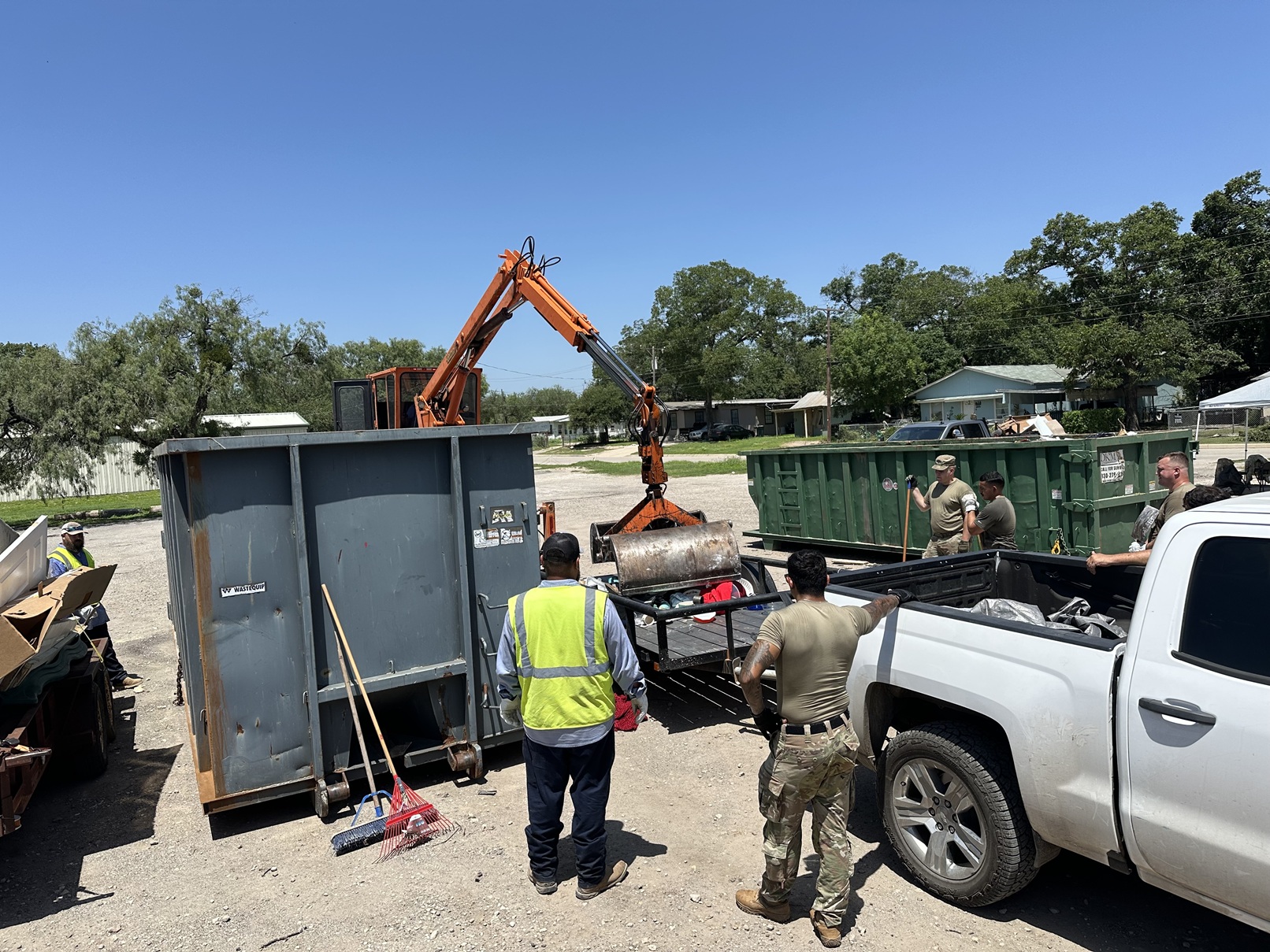
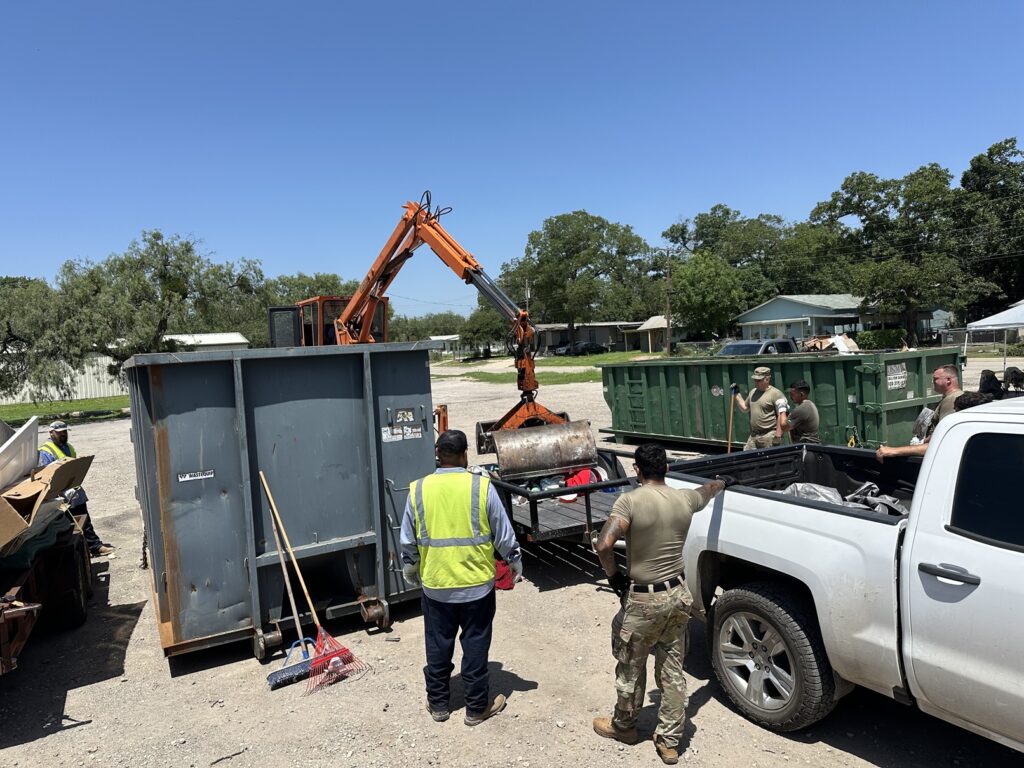
“I don’t know the names of the people I helped out today,” he said. But it did not matter. With his trailer, he was able to haul six loads of debris to the dumpsters across from Uvalde Meat Market set up by the National Guard. “I feel like I helped out a lot more today than yesterday because I was able to help out more people.”
As the National Guard was closing up operations for the day at two o’clock on Tuesday, my brother pulled up to a house on Wood Street across from the golf course. A second truck-and-trailer pulled up alongside him, strangers both of them, and together they hauled one final load to the dumpster.
In the middle of helping to haul trash, he noticed a ruined, mud-smeared photograph of a mother and father with their daughter in military uniform, possibly having graduated a military academy. It wasn’t just stuff he was hauling away; it was memories. “You realize people’s lives were affected in a negative way,” he said. “You want people to survive, sure, but you can’t move a house.”
In the interview, my brother talked of larger organizations that might ask volunteers to run a background check or complete other paperwork before heading out to the field. He stressed the urgency and the need of simply getting out there.
“You just need to come help these people,” he said. “You need some hands to load garbage. I have a trailer. I can devote what I have. Other people don’t have that.”
“I didn’t know I wanted to come until after the flood,” he continued. “I figured it was going to be just as bad, if not worse, than Kerrville [last year].”
After talking with affected flood victims, he concluded, “Y’all didn’t think it was going to be as bad as it was.”
My brother includes me in that assessment, and he is right. I did not know what to think. I spent the week checking on friends and neighbors as I thought of them, and praying for those I had not yet heard from. Thankful for the rain, I took notes on daily totals from my newly-installed rain gauge, reminding myself that 5” in one night is extraordinary and not to be thought of as the norm.
Looking outside my door last week, you would think there was no flood raging around me. The air was fresh and clean-smelling, the grass a bright green. I had a humming refrigerator stocked with fresh food. My children even splashed in the rain. It seemed there was no care in the world.
When my neighbor texted, “It’s bad, girl,” earlier in the week, I could hardly believe her. I did not venture out with my children until Friday when the waters began to recede and I gave them strict warning not to get out of the car. It was only through pictures my husband and others took that I realized the enormity of the tragedy.
“Nobody had flood insurance,” my brother told me after he came back from his rounds of debris-hauling. “One guy off Wood St. just built the house—he couldn’t get it. They wouldn’t sell it to him.”
My brother had come into town about 10:30 Monday morning, looking for a place to drop off a few donations he and some well-wishers had collected for the town. He made his way to the Dodson subdivision, where most of the residents and the Red Cross were busy with cleaning out flood-soaked houses. This was a hard-hit area, with some residents having had water inside their homes to the eight-foot ceilings.
Not even the Red Cross would take my brother’s donations at the time, but several homeowners took a few necessities. That is how he met the Cochrans.
“Jason pulled up to our house in his truck and asked if we needed help and offered supplies and drinks that he brought,” said Kim Cochran after the fact. “He immediately got to work.”
Chris and Kim Cochran, who hail from Fayetteville, AR and moved to Uvalde eleven years ago for work, currently live at the end of Private Road 4330 and had three to four feet of water in their home as a result of the flood. They have a 1978 split-level home located a little less than a half-mile west of the Leona River. Taylor Slough joins the Leona about a half-mile north of them.
According to David Fry with Medina Real Estate Photography, who was out last Wednesday and Thursday capturing the devastation with his drone camera, water from the swollen Leona River came within 20 feet of the south bend of Johnson Loop, which is nearly one-third of a mile (1,600 ft.) west of the center of the river and about that much further west of Private Road 4330. The footage shows the river over Old Pearsall Road up to 1,000 ft. west of the Dodson subdivision. That would make the floodwaters at this juncture 780 feet shy of a mile wide.
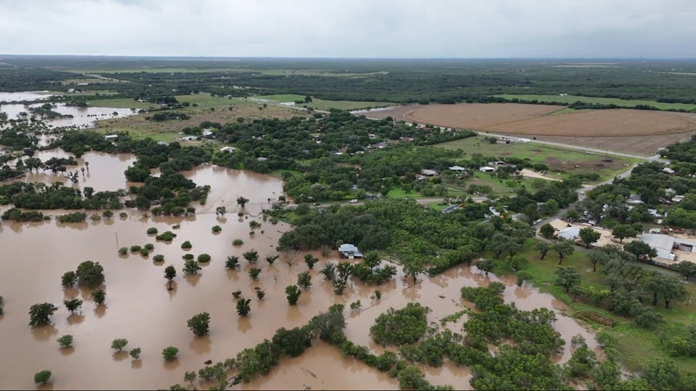
The elevation of the Dodson Subdivision stands between 895 and 897 feet above sea level. The elevation of the Leona River at the Old Pearsall Road bridge, located less than 1,000 ft to the west, is 890 feet. The Cochrans’ home was assessed to be “outside of the flood plain, so we expected everything to be okay,” said Kim.
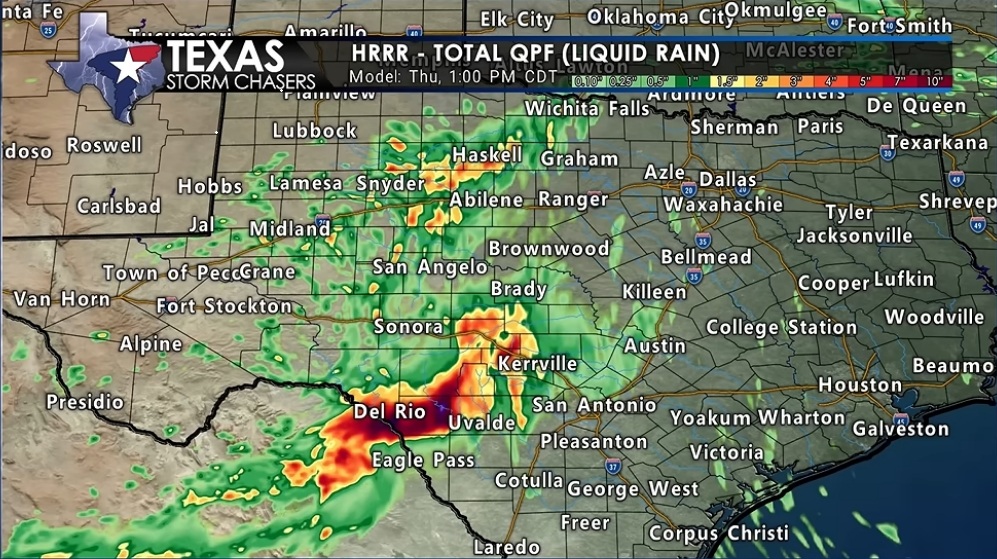
Uvalde County had received a considerable amount of rain by mid-week last week. According to David Reimer with Texas Storm Chasers, almost 17 inches had fallen just north of the city between Monday and Wednesday evening. Julye Keeble with the Uvalde Leader-News recorded that “more than 14 inches” had fallen in that same time frame. And more rain was on the way.
“Understand that the rivers out here are already forecast to be a major flood stage,” Reimer said as a warning to his viewers in the Uvalde area in his July 15 evening update. “Any additional rain will just exacerbate that and just push things that much higher.” His models predicted an additional 10 inches of rain in or near the Uvalde area in the overnight hours of Wednesday into Thursday.
“Given what we’ve seen the last couple of days, it’s entirely possible someone could get a foot, a foot and a half of rain tonight… If you live in an area that is near the river, creek, streams, pay attention and skedaddle if you need to skedaddle because this is going to get rowdy real quick overnight,” he warned.
According to my brother, the Cochrans did not think they were close enough to the river to be affected by its floodwaters. “Prior to the flooding, we actually discussed it among our neighbors and a few others in the area on Wednesday afternoon,” Kim wrote in an email interview. “The consensus was that it would probably flood the slough and we would be cut off from town, and the field to the side of our house would be boggy, but that we would be okay.”
Wednesday night saw the heaviest rainfall totals of the severe weather event. The rain gauge at my house, which is 3.2 miles northwest of the Cochrans, recorded 5 inches that night. Three point two miles due north of them is Garner Field Road, where Carol Kothmann reported “more than 11 inches overnight into July 16.” It seemed David Reimer’s predictions had come true.
All that water flowed south. By 5 A.M. Thursday morning, many along Private Road 4330 had evacuated their homes by boat, but no one had been able to get in touch with the Cochrans to see if they were all right.
“My family had slept through the storm and all the notifications on my phone, as well as the neighborhood text thread trying to get ahold of us as everyone on our street evacuated,” Kim wrote. “My next door neighbor Crystal Alejandro-Jiminez called me at about 5 AM… and told me all the neighbors down the street were actively being evacuated by boat.
“We declined evacuation from [the Texas Game Warden’s] Game & Fish swift water rescue,” she continued. “We discussed it and made a ‘plan b’ to evade water if it continued to come up. The east side of our property is higher, and the neighbor’s house to the southeast a little higher, so we still had a place to go if the water continued to rise even if we had to cut the fence to get out.”
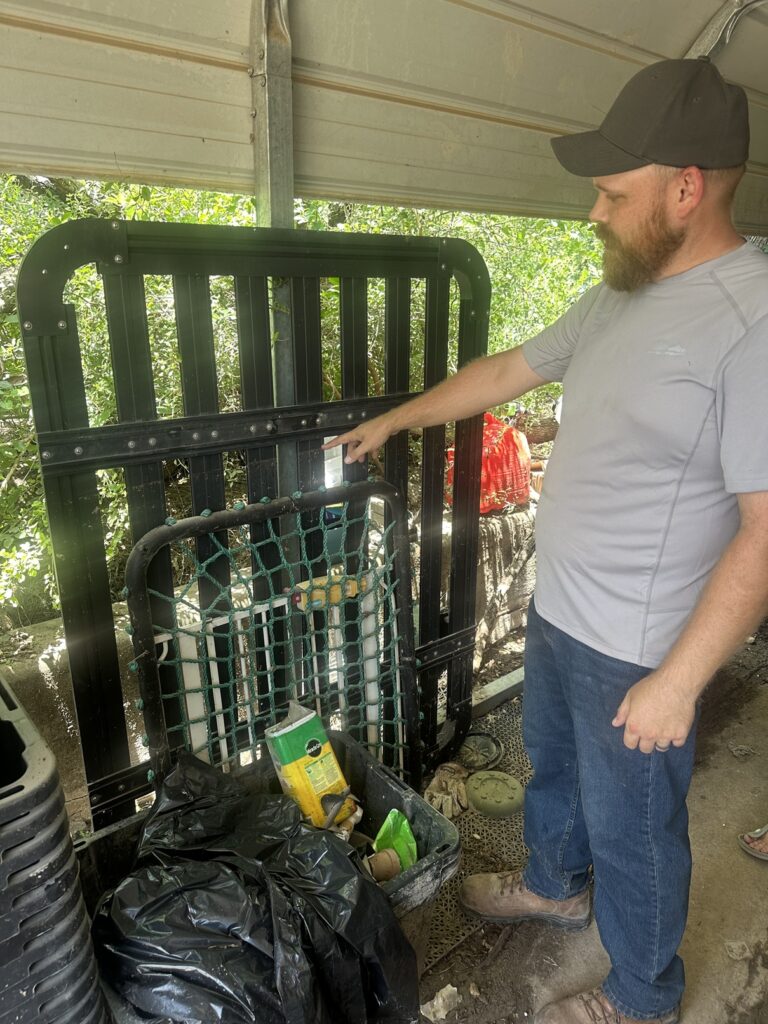
Plan B proved unnecessary, but the floodwater ravaged their home. “The entire first floor of our home and large four-car carport workshop was flooded with over 3 ft. of water,” Kim reported. “The septic tank was totally flooded and a retaining wall was washed away. We saw on a home security camera feed that our old Volvo was floating like one-to-two ft. off the ground and set back down about three ft. to the left of where it was, so that’s a total loss.” Additionally, the carport acted as a catch-all for whatever the river had collected and floodwaters filled it with all manner of debris.
“We do plan to stay,” she added, “but plan make significant modifications to try to prevent this from happening again.”
Thankfully, by 9 A.M. that morning, the storm had fizzled out and no more rain came. By 3:20 that afternoon, the floodwaters had started to recede. By late Thursday night, the Cochrans were able to make it out of their subdivision.
It was life-saving that the Cochrans stayed behind in their home. Their next-door neighbor contacted them about cats, a fifteen year-old senior and six foster kittens, trapped in the adjacent home. Immediately Chris jumped into action, and waist-deep floodwaters, to rescue them. He found them in a bathroom, soaking wet and exhausted from trying to keep their heads above water, and floated them out of danger in a plastic bin he had scavenged among the debris.
“To say I was relieved to see him coming back down the street intact is an understatement,” his wife wrote, “since, if the water was too strong for him, there was no way I could get to him quickly and I couldn’t leave my girls.”
“It probably meant the world to those people I helped yesterday,” my brother told me later.
Indeed, it did. Both Chris and Kim assured me that my brother was “a massive help” in their recovery efforts. “Jason was such a blessing in both physical help and boosting our spirits,” Kim said. Not only did he help them with the “huge job” of debris-hauling, “He also helped immensely by simply visiting with us while we were working, especially my husband. Most of our friends and all our families live 700 miles away or more, so my husband shoulders a lot by himself. During the course of the day, Jason and Chris discovered they have so much in common interests…”
“We could be twins,” my brother told me when I dropped off his lunch. “I know we’re twins,” he stressed—which is true—“but he and I could really be twins. He even loves Star Trek!”
Because the floodwaters only reached the lower portion of the house, the Cochrans are able to stay in their home, which is not the case for some flood victims. They were certainly among the more fortunate in this disaster.
“I’m usually the one helping others,” Chris Cochran told me. “It’s hard to be the one to accept help.”
After assisting the Cochrans most of the day Monday, my brother was finally able to give his donations to the community by way of the staff at Sacred Heart Catholic Church, who eagerly received them. Sacred Heart has set up recovery efforts at the CCD building on its Ft. Clark Road campus. Please contact the church office at 830-278-3448 for more information.
As I think about the flood and its impact, what keeps coming back to mind is a verse from Ecclesiastes: “The race is not to the swift nor the battle to the strong, nor bread to the wise, nor riches to men of understanding, nor favor to men of skill; but time and chance happen to them all (9:11).”
In the coming weeks, months, and years, no doubt there will be plenty of blame to smear in people’s faces in regard to this storm, but sometimes life just throws us a curve ball and the best we can do is swim for dear life while praying God sends us rescue. Sometimes that rescue comes in the form of an out-of-towner—or a twin brother—just looking for a way to help out his fellow man. It may takes weeks for Uvalde to get back on her feet, but with friendly volunteers like Jason Lowery, there will be no shortage of helping hands to go around.